Example package
Pre-launch security review
A review of your app's data access, keys and logins, with the fixes made.
You get
- A written list of every issue found
- Database access rules repaired
- Keys moved out of the front end
- A re-test after fixes

You built an app in Lovable, Bolt, Replit or Bubble and it is most of the way there. We find what is broken or unsafe, finish the missing pieces, and move it to hosting you control, so you can launch with confidence.
Tell us what you needSee typical projectsYou know what you're getting before work begins.

What we hear from businesses before a project like this starts.
The requests that come up most often for this kind of work, and what each one takes to work properly.
Database access rules, exposed keys, authentication and permissions checked before launch.
The missing screens, flows and edge cases built and tested.
The app exported and deployed to AWS, Vercel or a server in your own account, in the region you need.
Stripe, transactional email and sign-in flows completed and tested end to end.
Each bug repaired in the code itself, with tests so the next change doesn't undo it.
Data and logic moved to a stack you can grow, in stages.
Tools that come up most: Lovable, Bolt, Replit, Bubble, Supabase, React, Vite, Next.js, Stripe, Vercel, AWS, GitHub.
Concrete pieces, each one something you can open and check when it's done.
Row-level security, keys, authentication and permissions checked and repaired.
Supabase RLS, auth, secret managementMissing screens, flows and edge cases built in the existing code.
React, Supabase, your stackThe app running in your own hosting account with a proper build and release process.
Vercel, AWS, Docker, GitHub ActionsStripe checkout and subscriptions, and email that arrives.
Stripe, transactional email servicesTests for the important flows, so changes stop breaking things.
Playwright, unit testsThe code in your GitHub, documented, so any developer can continue.
GitHub, READMEExample packages to show the shape of the work. These are examples, not past clients; yours gets its own written scope.
Example package
A review of your app's data access, keys and logins, with the fixes made.
You get
Example package
The agreed list of missing features built and tested.
You get
Example package
The app moved from the builder to hosting in your own account.
You get
Example package
Sign-up, login, subscriptions and email working end to end.
You get
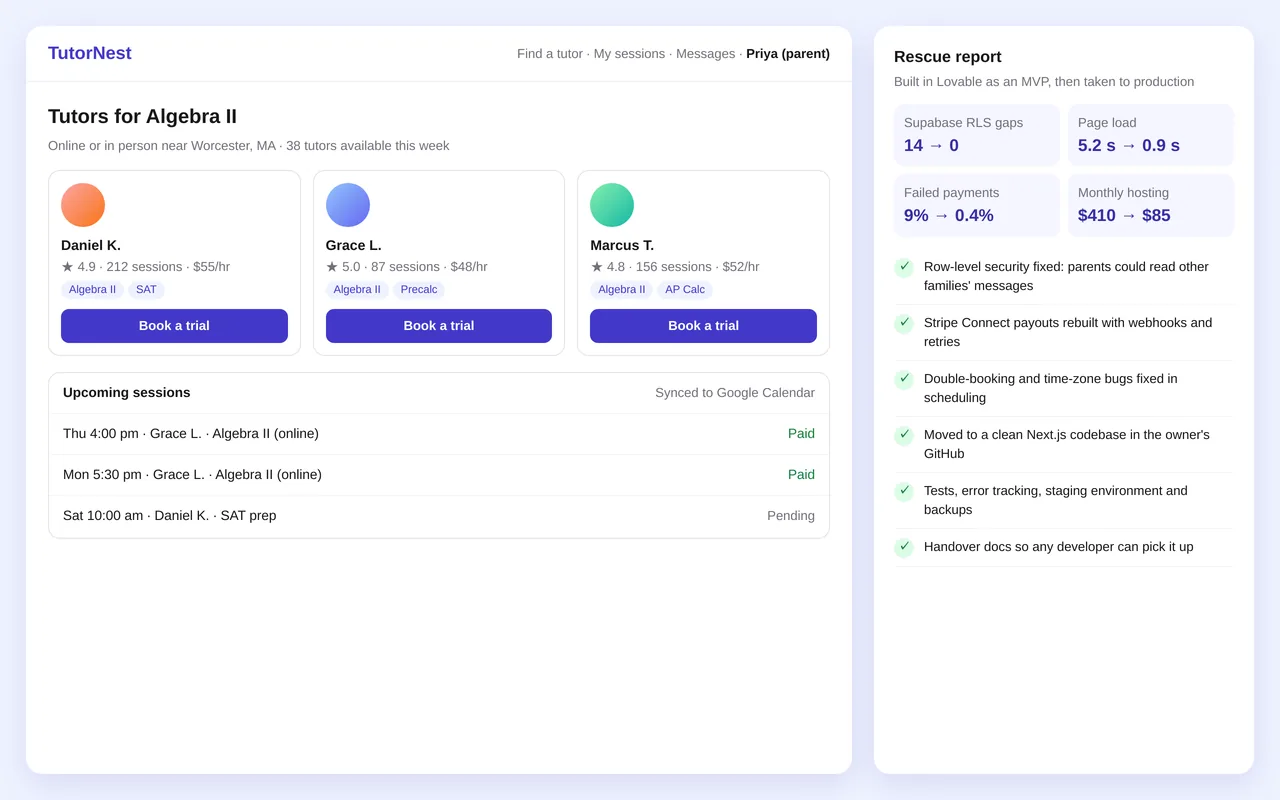
TutorNest's founder built a tutoring marketplace in Lovable and got real families and tutors using it, then hit the wall. Security rules were leaking data, payouts failed, scheduling broke across time zones, and every change risked breaking something else. We audited the app and closed 14 database security gaps. We rebuilt payments and repaired scheduling, then moved everything to a clean codebase in the founder's own GitHub with tests, a staging environment and monitoring. The product looks the same to its users; underneath, it is ready to grow.
Lovable export, Next.js, TypeScript, Supabase (Postgres, auth, RLS), Stripe Connect, Sentry, Vercel
A working example we built to show this kind of work. It is a demonstration, not a client project.
Sample build
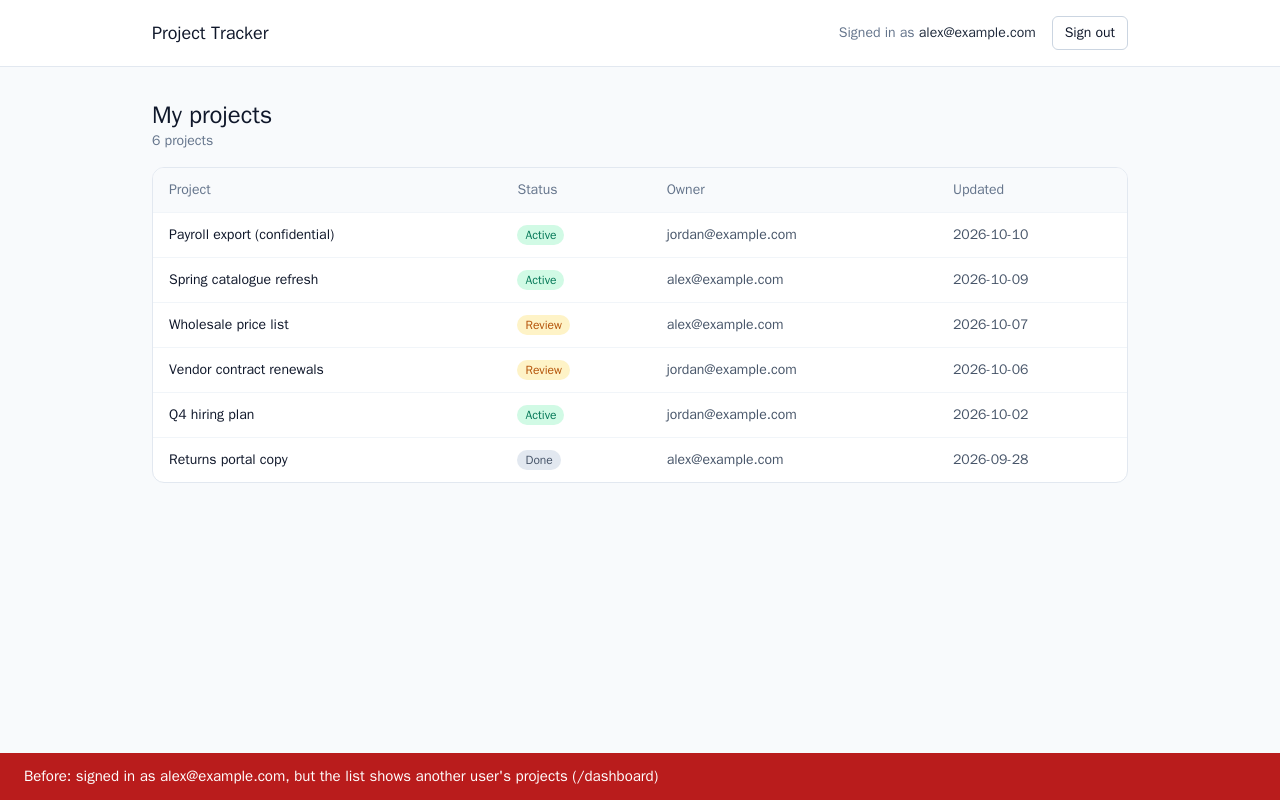
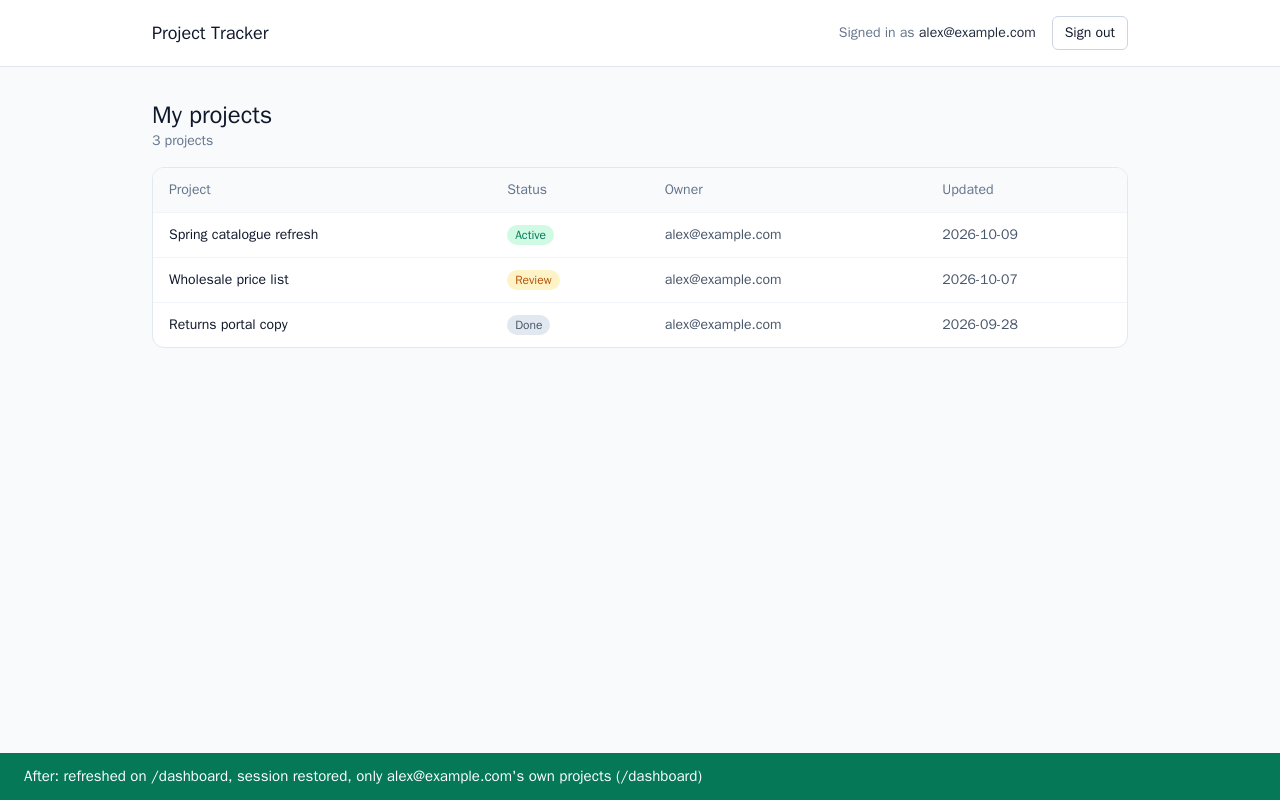
A project tracker in the shape that builders like Lovable or Bubble produce had four bugs: signed-in users were sent back to the login page on every refresh, the protected page flashed before redirecting, every user saw everyone else's projects, and the previous user's list stayed cached after sign-out. Each fix ships as a patch with a bug, cause and fix note plus the matching row-level security policy.
React 18, Vite, TypeScript, Tailwind CSS, React Router, TanStack Query, Supabase-style client (local mock), Docker
About the screenshots: A sample React app built for this demonstration in the style those builders produce (not exported from Lovable or Bubble), shown before and after the fixes.
The habits that keep this kind of project from going wrong.
We look through the code and database before writing the scope, so it reflects what is really there.
Data access and keys are secured before new features, because they are the expensive problems after launch.
We finish and fix the existing app. Rebuilding is only proposed with a clear reason.
Code in your GitHub, hosting in your name, so you are not locked in.
You describe it. We write it down, build it, and hand it over.
Tell us what you need in your own words, and which tools you already use. A few lines is plenty to start.
We reply with a short written scope: what gets built, what is out of scope, which accounts we need, and how we'll both know it works. You know what you're getting before work begins.
The work is split into milestones. At each one you see it working in your own account and sign it off before we go on.
You get the working system, its documentation and a walkthrough. If anything we built breaks in the next 30 days, we fix it at no charge.
Pushbuild has built software for businesses since 2010, for more than 40 clients. Every project is led by a former public-company CTO, from Groton, Massachusetts. See products we've built.
Usually yes, through the GitHub sync. We tell you in the scope if any change would make that harder.
Not unless there is a clear reason, which we would explain in the scope. Most prototypes are worth finishing.
Access to the builder project or GitHub repository, and to the database. You can remove it at handover.
You do. Code in your GitHub, hosting and database in your accounts.
A security review takes a few days; finishing features or moving hosting one to three weeks from the signed scope.
For 30 days we fix anything we built that does not work as the scope describes, at no charge. After that, we scope any further work with you first, so there are no surprises.
Email a few lines about what you want and which tools you use, or call. We reply with questions or a written scope.
hello@pushbuild.com