Software that connects dispatch, tracking and invoicing for a logistics company.
Freight data tends to live in three or four places: the TMS, the tracking portal, the carrier's emails and a spreadsheet someone keeps. We connect them so a load is entered once, customers get status without calling, and invoices go out when the paperwork is in. The scope is written down and agreed before we start.
Illustrations of the shape of the work, not past clients. Yours gets its own written scope.
Example project
Split freight data into one dashboard
Example: a regional freight operation has tracking, dispatch and invoicing in separate tools. The data is pulled nightly into one dashboard with a line for each load and its billing state.
APIs, a small database, Looker Studio
Example project
Proof of delivery to invoice
Example: a brokerage receives delivery photos from drivers. Each one is read, matched to its load, and the load is marked ready to invoice with a draft in the accounting system.
Email, PDF extraction, QuickBooks
Example project
Where is my load text
Example: a small carrier lets customers text a load number and get back the latest status from the dispatch record, with a person taking over if the answer is unclear.
Twilio, the dispatch system API
Example build
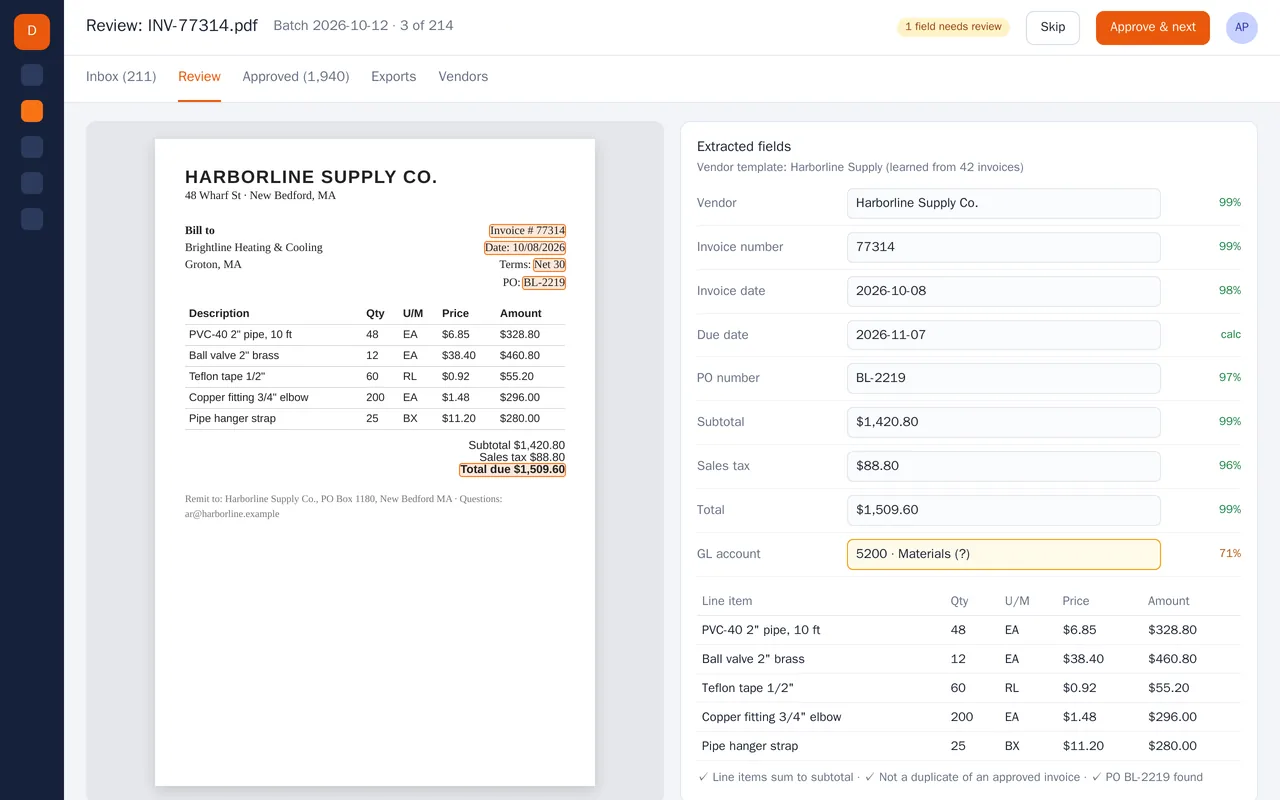
Supplier invoice extraction for an accounts-payable team (PDF to structured data)
PDF and scan ingestion from a shared inbox and a watched folder
Header and line-item extraction with per-field confidence scores
Per-vendor templates that improve as invoices are approved
Checks: line items vs subtotal, duplicate detection, PO match, GL account suggestion
Python, OCR, layout-aware PDF parsing, LLM extraction with validation rules, PostgreSQL, React
Questions people ask first
Our TMS is old. Can you still connect to it?
Often, yes. If it has an API we use it. If it only exports files or has a web portal, we can usually work from those. We check this first and tell you in the scope.
Do we have to replace our systems?
No. The aim is to connect what you have and remove the retyping between them.
Who owns what you build?
You do. It runs in your own accounts, with notes on how it works so your team can change it later.
How do we start?
Tell us which systems hold your loads and where the most retyping happens. We reply with questions or a written scope.